
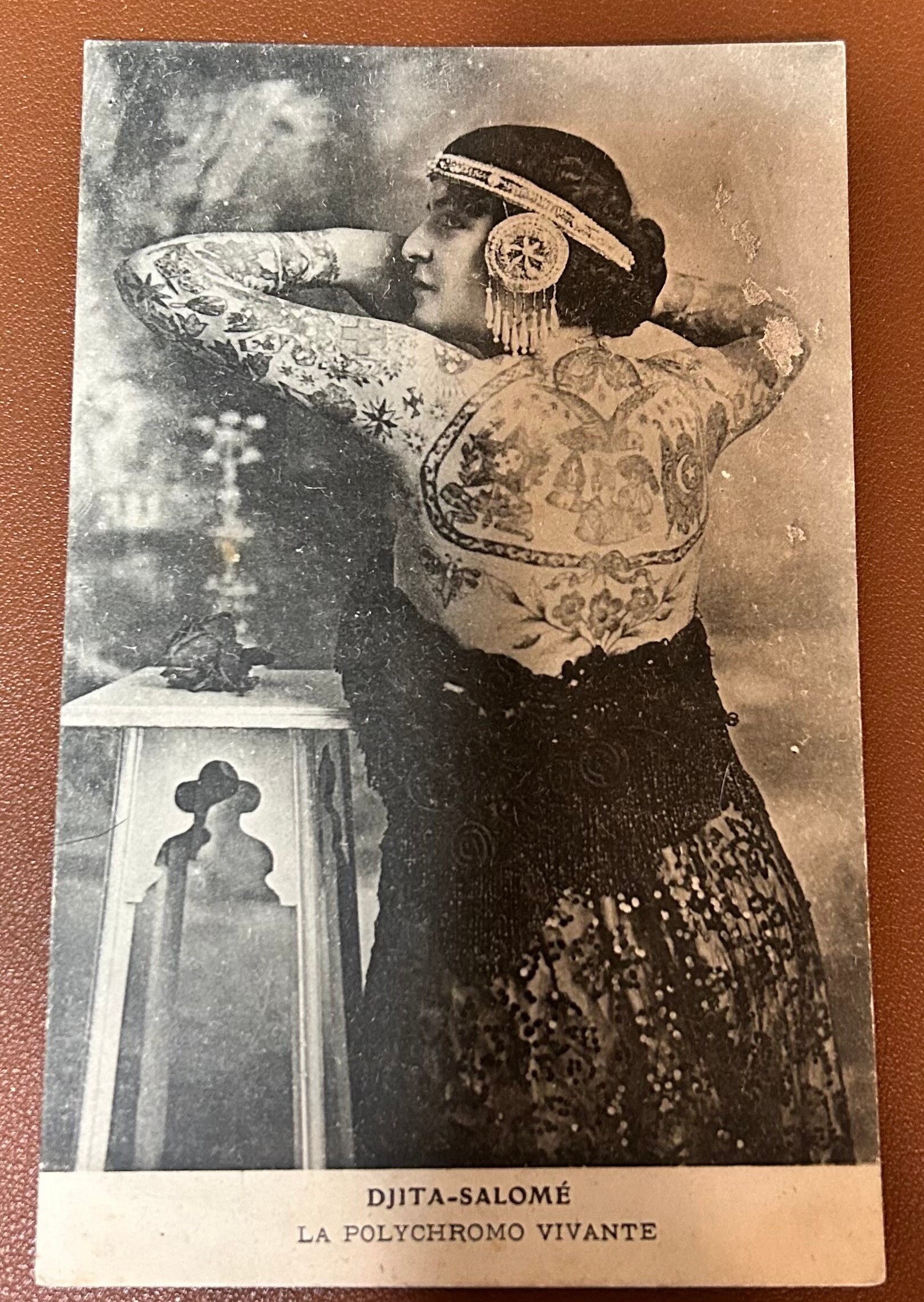
The Woman Who Became a Canvas
Every so often, a postcard arrives that doesn’t politely join the collection — it makes an entrance.
This one traveled to me from France after a late-night online auction victory (the most dangerous kind of victory). She is labeled simply:
DJITA-SALOMÉ
La Polychromo Vivante
Which translates, delightfully, to “The Living Polychrome.” In other words: a living work of art.
And truly — look at her.
Djita-Salomé stands in profile, her back turned just enough to reveal an extraordinary canvas of tattoos stretching from shoulder to wrist and across her entire back. Florals. Stars. Symbolic motifs. Ornamental framing. Narrative scenes. Her skin isn’t just decorated — it’s composed.
The staging is classic early 20th-century studio drama: soft-focus backdrop, decorative pedestal, a carefully placed prop (and yes, that appears to be a frog). Her headband and jewelry lean into an exoticized aesthetic popular in European performance circuits of the time. This wasn’t accidental. This was branding.
Because postcards like this weren’t private photographs — they were promotional tools.
During the late 19th and early 20th centuries, heavily tattooed women toured circuses, music halls, and sideshows across Europe and the United States. Performers often crafted elaborate origin stories — tales of captivity, faraway islands, or ritual markings — to heighten intrigue. Whether those stories were true, partially true, or entirely theatrical mattered less than the spectacle itself. The tattoos were both rebellion and revenue.
And here’s what I love most: Djita-Salomé does not look ashamed. She does not look hidden. She looks composed. Intentional. Aware of exactly what she is presenting.
There’s a tension in pieces like this that I always want to sit with.
On one hand: spectacle culture, exoticism, and the commercialization of difference.
On the other: agency, self-fashioning, and a woman literally turning her body into art in an era when women’s autonomy was tightly constrained.
Was she exploited? Empowered? Both? That ambiguity is part of the artifact.
The print itself shows its age — soft wear at the corners, silvering in the shadows, the gentle toning that only time can give paper. It’s not pristine. It’s lived. And that feels right for a piece centered on skin as story.
What fascinates me most is the phrase “La Polychromo Vivante.” Today, tattoos are commonplace. In her era, full-body tattooing — especially on a woman — was shocking, magnetic, and profitable. She wasn’t just tattooed. She was marketed as color incarnate. A walking gallery.
This postcard is more than a sideshow relic. It’s a document of early modern tattoo culture. Of performance identity. Of how women navigated visibility in a world that both consumed and constrained them.
And somewhere in France, over a century ago, someone bought this postcard to remember her.
Now she lives here.
And more than a century later, she still refuses to fade into the background.


A Gentle Smile in a Straitjacket
I found this photo the way all the best ephemera enters my life: slightly past my bedtime, heart racing, finger hovering over the bid button, during Courtney’s (darkroomvintage) Whatnot auction. You know the kind—the one where you tell yourself “I’m just watching,” and five minutes later you’re emotionally invested in a stranger from 1945. Courtney, as always, delivers the good stuff, and this one stopped me cold.
This photograph was taken at General Hospital in Cincinnati, Ohio on November 6, 1945, and the handwritten note on the back tells us the man’s age: 67. That alone would make it compelling. But then you look closer—and realize he’s wearing a straitjacket.
Let’s talk about the style for a moment. This is not a family portrait. There’s no backdrop prop, no Sunday suit, no attempt at glamour. This is a clinical hospital identification photograph—plain background, simple lighting, direct gaze. It was taken for record-keeping, not remembrance. And yet, somehow, it’s deeply personal. His posture is relaxed. His expression is almost… amused? Like he’s in on a joke the rest of us haven’t heard yet. Which, frankly, makes the straitjacket even more unsettling—and more fascinating.
In 1945, restraints like this were standard practice in hospitals, especially for psychiatric patients, elderly patients with dementia, or people experiencing neurological or psychological distress. This was the era of “senility” diagnoses, overcrowded wards, and very few patient rights. A 67-year-old man could be institutionalized for things we’d now recognize as Alzheimer’s, depression, post-stroke confusion, or simply being unable to live independently. The straitjacket wasn’t a punishment—it was just… protocol. (Which somehow doesn’t make it less eerie.)
And yet—he doesn’t look dangerous. He doesn’t look lost. He looks human. He looks like someone’s uncle. Someone’s neighbor. Someone who probably had opinions about coffee and weather and whether things were better “back in his day.”
That contrast is exactly why this piece is such powerful ephemera.
This photo captures:
-
post-WWII medical history
-
early psychiatric care practices
-
institutional photography as a genre
-
and the uncomfortable space between care and control
It’s unsettling, yes—but also tender. And a little absurd, in that dark, history-nerd way where you can’t help but laugh quietly and then immediately feel guilty about it.
That’s why I love this piece. It doesn’t tell you what to think. It just sits there, calmly, smiling faintly, daring you to look longer.
And honestly? Any photograph that can make you feel curious, sad, uncomfortable, and weirdly fond of a man you’ve never met—that’s top-tier ephemera.